
Articles
A1 Certificate Exemption for Short-Term Business Travel: What Employers Need to Know
A new EU provisional agreement would exempt short-term business trips from A1 certificate requirements. But the rules are nuanced - here's what employers should know

.avif)
A1 Certificate Exemption for Short-Term Business Travel: What the Law Actually Says
Rumours have it that A1 certificates will be abolished for short-term business trips within the EU. But will they? In April 2026, the Committee on Employment and Social Affairs of the European Parliament reached a provisional agreement that would, among other things, introduce an A1 certificate exemption for short-term business travel. The adjustments still need formal adoption by the European Parliament and European Council - and even if adopted, the full picture is more nuanced than the headlines suggest.
In this article, we explain the background of the rumours, and elaborate on if anything will actually change, what these changes would exactly entail, and when they would come into force. This analysis is based on the officially suggested legislative amendments. Let's not go with rumours - let's try to understand the law.
The EU regulations behind the A1 certificate
The EU social security coordination rules are mainly laid down in two EC Regulations: 883/2004 on the coordination of social security systems, and 987/2009 laying down the procedure for implementing this first Regulation. In short, these Regulations exist for two reasons:
- to ensure that people within the EU are adequately covered by only one social security system, also if they work across European borders, and;
- to coordinate and fairly distribute the administrative and financial burden of social security across the EU countries.
Now, a procedure to amend these Regulations, that has been ongoing for almost a decade (!), is nearing its finale. The envisioned amendment of the Regulations is aimed at modernising the EU law on social security, as well as to facilitate administrative simplicity and enforceability of the rules. Almost ten years after the initiation, the Committee on Employment and Social Affairs of the European Parliament reached a provisional agreement on the suggested adjustments. This is where the rumours come from.
However, it is important to know that the adjustments still need to be submitted for formal adoption by the European Parliament and European Council.
Will the A1 certificate changes actually be adopted?
The legislative process for the suggested changes has not only taken almost 10 years, it has also been rather bumpy. An earlier Provisional Agreement collapsed in 2019. Truth be told, things look different for the current agreement. It was agreed upon with a very significant favourable vote in the Committee; 47 in favour, with only 3 against and 4 abstentions. Furthermore, given the long process and previous failure, it is expected that the people behind the current agreement made sure to already align the various stakeholders behind the scenes, before pushing it again to the European Parliament and European Council. At the same time, exactly this long process and previous failure make clear that the topic and the amendments are difficult for the politicians to agree upon. Additionally, even for topics with broad consensus, the European Parliament and especially the European Council often make further adjustments and sometimes still reject. Even though there are positive signs for the amendments at hand, the actual adoption remains insecure.
What would change for A1 certificates under the new EU rules
Even though the core content remains largely unaffected, a wide variety of adjustments will be implemented. Some of those adjustments are indeed related to A1 certificates. Below, we address the three key changes in this area. ! Please note that the changes do not apply to COCs, as they are not based on the EC Regulations, but on bilateral social security agreements.
1: Short business trips will not require an A1 certificate
Short trips will not require an A1 certificate.
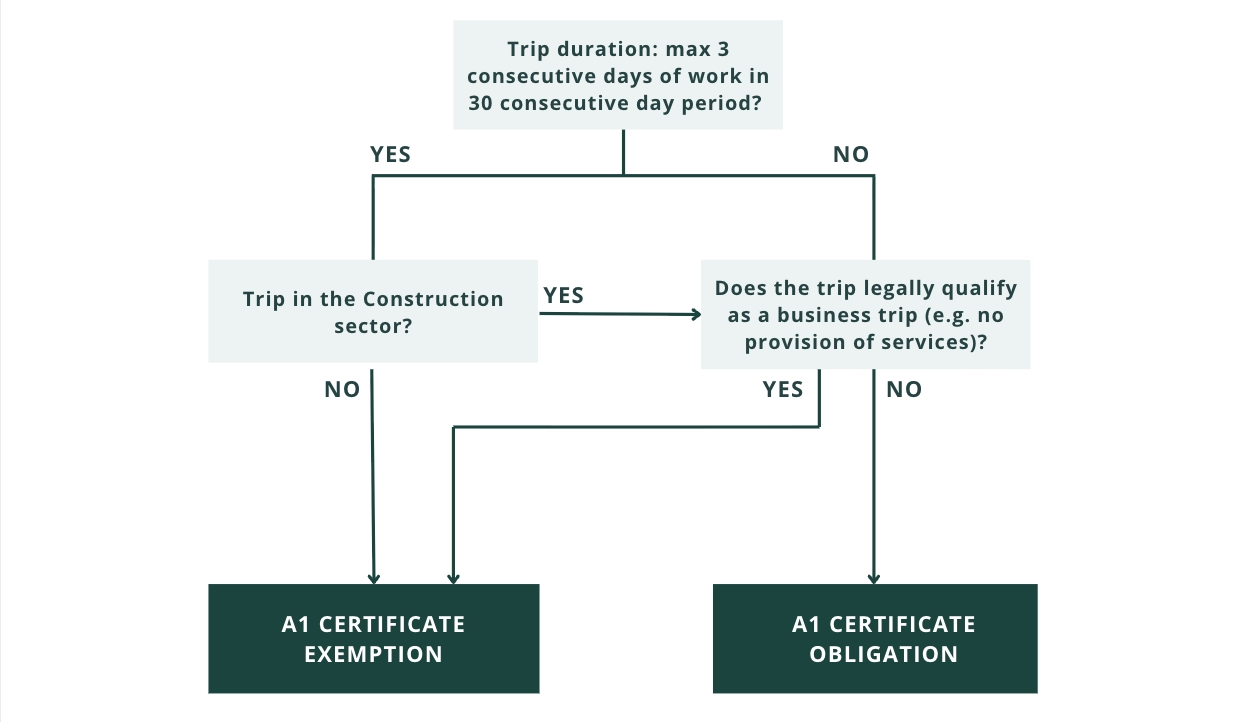
Short trips are trips with a total duration of no more than 3 consecutive days of work. However, for this exemption to apply it is not sufficient to just count a single trip; it is to be considered looking at a period of 30 consecutive days.
It remains unclear when a day exactly qualifies as a “day of work”, but based on other (European) legislation, probably any activity on a day would make that day a day of work, regardless of the scope or actual duration of the activity. It also remains unclear how the 30 day time period exactly works, but again based on other (European) legislation, probably any running 30 day period should be taken into account. A complexity will arise if a trip retrospectively turns out not to meet the exemption condition:
- A traveller goes on a 3 day trip to Germany to install a machine. He was not in Germany the month before, hence no A1 certificate is required.
- In the week after the first trip, it turns out that the traveller has to go to Germany again for further installation, this time for a 5 day trip. The second trip would not be exempted, but retrospectively the first trip would also require an A1 certificate after all.
Data and analysis available to the European legislator indicates that the construction sector is sensitive to fraud, irregularities and abusive practices, and that both the number of accidents at work, including fatal accidents, and their incidence rate are particularly high in these activities. Consequently, the construction sector is excluded from this exemption. Construction work is all work related to building, repair, maintenance, alteration, or demolition of buildings.
2: Certain business trip purposes will be exempt from A1 certificates
Additional to the first exemption, (longer) “business trips” with specific trip purposes will also not require an A1 certificate. These are “business trips” that qualify as: “a temporary activity as an employed or self-employed person, which is limited in time and which is related to the business interests of the employer or, in the case of a self employed person, the person concerned, excluding the provision of services or the delivery of goods, but including attending business meetings, cultural and scientific events, conferences and seminars, such as those related to academic research, or receiving training".
The definition makes clear that business trips during which services are provided or goods are delivered will continue to require an A1. Trips for business meetings, cultural and scientific events, conferences and seminars, and receiving training will qualify as business trips. Any trips with a trip purpose other than the ones mentioned, will need to be qualified on a case by case basis. As workations are not in the “business interest of the employer”, they will not qualify as a business trip. This means that, unless they would be short (number 1), they require an A1 certificate.
The exemptions under 1 and 2 create an administrative relief, but they do require employers to identify any upcoming trips, and assess whether the (accumulated) duration or trip purpose triggers the obligation to apply for an A1 certificate after all.
3: A1 certificates must be applied for in advance
A1 certificates are already a firm compliance requirement, but the current text of the EC regulations does not stipulate that they have to be requested upfront. Moreover, enforcement of A1 certificates has historically been uneven across member states, partially given the absence of international exchange of information.
The new EC Regulations will change this. Not only will they include an obligation to apply for an A1 certificate prior to the trip, unless either exemption under 1 or 2 is applicable. The requirement to hold an A1 is not new, but the obligation to secure it in advance will be. Furthermore, the changes to the EC regulations will drive the exchange of information between states. Both the A1 obligation and the information sharing are expected to lead to much stronger enforcement of the rules. This is a trend that can already be observed, e.g. by the introduction of ETIAS, increased (digital) border controls and the recent spike in social security audits by local authorities across the EU.
The figure below shows the decision tree to determine whether or not a trip requires an A1 certificate under the new EC Regulations.
When will the A1 certificate exemption take effect?
It is important to repeat that it is still unclear if the amendments will at all be adopted in the current form.
If they do, this process is expected to take approximately six months. After the adoption, the EC regulations will come into force relatively quickly after their publication. Unlike European Directives, they do not need to be translated into national law. However, especially for the adjustments in the area of A1 certificates, the amendment document already suggests a 24-month transformation period. This allows the states and authorities to implement structures and adjust processes and documentation. Many European initiatives that require such implementation and adjustments, tend to take much longer than predicted. The ETIAS regulation was adopted in 2018, which the go live date planned for 2021. It has been postponed six times since then, and is currently planned for a go live end of 2026. The EC Regulation 883/2004 originates from 2004, but did not come into effect before the implementation EC Regulation 987/2009 was adopted in 2009. The latter, however, included another 24-month implementation period, pushing the effective application date to 2011.
Taking the aforementioned into consideration, it is expected that - if the amendments are adopted - it will take up at least 2,5 years - but more realistically 3,5 to 4 years - to become applicable.
That at least leaves for enough time to clarify the many questions that cannot be answered at the moment. For example, it is unclear:
- whether a unified system for the A1 applications will be announced – or whether the current decentralised set-up of country-specific systems remains;
- whether and when the non-EU countries that work with A1 certificates (Switzerland, Norway, United Kingdom, etc.) will adopt the new EC Regulations;
- if there will be a clearer definition of the terms “business trip” and “service provision”;
- how exactly the 3 and 30 day thresholds should be counted;
- how the exemptions relate to Posted Workers Directive (PWD) notifications, which currently often have the application of an A1 certificate as a requirement;
- whether companies will adjust their (e.g. worksite/factory) entry requirements, which also often includes the availability of an A1.
What this means for employers managing A1 certificates and travel compliance
It is still uncertain whether and when the new EC Regulations will be adopted by the European Parliament and European Council. If they do, it will still take up to four years for any A1 changes to come into effect. If they then finally do, less A1-certificates need to be requested. From that perspective, the original objective of the amendment procedure will be fulfilled. However, the administrative “win” will be offset by the necessary efforts to track trips, and assess based on duration and trip purpose if an A1 certificate is mandatory or exempted. Authorities will increase their efforts to have employer comply with the amended Regulations. After all, simplification was not the only objective of the amendment procedure; better enforcement was too.
How WorkFlex automates A1 compliance
WorkFlex eliminates the guesswork around A1 certificate requirements by automating compliance for every trip request. Here's how our platform works:
- Intelligent trip assessment: For each business trip, WorkFlex captures trip purpose, duration, and activities, then automatically determines whether the new business travel exemption applies or if an A1 certificate is required.
- Automated A1 processing: When certificates are needed, WorkFlex handles the entire application process automatically across 30+ countries, ensuring compliance without manual intervention.
- Real-time regulatory updates: As the exemption framework evolves through the legislative process, WorkFlex's compliance engine updates automatically to reflect the latest requirements.
That includes tracking trip frequency against the 30-day rolling window and applying sector-specific rules - so your team never has to interpret evolving rules manually.
The result: your employees submit travel requests, and WorkFlex ensures complete compliance - whether that means confirming exemption eligibility or securing the necessary A1 certificates behind the scenes.
💡 See how WorkFlex manages A1 certificate compliance for your organisation: WorkFlex A1 Certificate Solution
Frequently Asked Questions
Does the EU provisional agreement mean A1 certificates are no longer required?
No. The provisional agreement would exempt trips of up to three consecutive days of work within a rolling 30-day period. Trips in the construction sector are excluded entirely, and any trip whose accumulated duration exceeds the threshold would still require an A1 certificate.
What counts as a "day of work" under the new A1 rules?
The provisional agreement does not define this precisely. Based on comparable EU legislation, any activity carried out on a given day would likely qualify that day as a day of work, regardless of the activity's actual duration or scope.
Will workations be exempt from the A1 certificate requirement?
No. Workations are not considered to be in the business interest of the employer and therefore do not qualify as a "business trip" under the new definition. Unless they fall within the three-day exemption, workations will continue to require an A1 certificate.
Does the A1 certificate exemption apply to Certificates of Coverage (CoCs)?
No. CoCs are governed by bilateral social security agreements, not by Regulation (EC) 883/2004, and are therefore unaffected by the provisional EU agreement.
What happens if a short trip is later extended?
If a trip initially qualifies for the three-day exemption but is later extended - for example, if the worker has to return to the same country for follow-up work within the 30-day window - an A1 certificate would retrospectively be required for the original trip as well.
Will A1 certificates need to be applied for in advance once the new rules take effect?
Yes. For trips that fall outside the exemption, the new framework introduces an obligation to apply for an A1 certificate prior to the trip - meaning A1 certificates will shift from being widely treated as "nice to have" to being a strict requirement.
When will the A1 certificate exemption take effect?
No confirmed date has been set. The provisional agreement still needs formal adoption by the European Parliament and European Council, after which a 24-month transformation period is foreseen. Realistically, the changes are expected to take 2.5 to 4 years to become applicable.
.avif)
Let WorkFlex handle A1 certificates for your business trips
With one click, your employees are protected from social security risk when traveling abroad, with regulatory changes automatically embedded in our compliance logic
Let WorkFlex handle A1 certificates for your business trips
With one click, your employees are protected from social security risk when traveling abroad, with regulatory changes automatically embedded in our compliance logic
Let WorkFlex handle A1 certificates for your business trips
With one click, your employees are protected from social security risk when traveling abroad, with regulatory changes automatically embedded in our compliance logic
Let WorkFlex handle A1 certificates for your business trips
With one click, your employees are protected from social security risk when traveling abroad, with regulatory changes automatically embedded in our compliance logic
related posts


With WorkFlex, compliance is no longer a roadblock to business travel, assignments and workations
Join hundreds of companies managing their international trips compliantly