
Global mobility COMPLIANCE
Send employees safely to Taiwan
Planning a workation, a business trip or assignment to Taiwan? Learn the essential information you and your employees need to work safely and compliantly while traveling in Taiwan, including working conditions, safety and health regulations, tax treaties, social security, and more.


Download Compliance Guide for Taiwan
As an employer, there are many things you need to consider before sending an employee to Germany. A handy PDF downloadable for free.
What you can expect
Capital city
Taipei
Telephone code
+886
Official language
Mandarin Chinese (official)
Currency
New Taiwan Dollar (TWD / NT$)
Time zone
UTC+8 (Taiwan Standard Time, TST)
Visa
To work legally while in another country, employees generally need avalid work title. It's important to keep in mind that the consequences ofentering without the proper documentation can be significant for both the employee and the employer.
For those planning an assignment, business trip or work-from-anywheretrips to Taiwan, here's a quick overview:
MUST-KNOW for Assignment in the Taiwan:
- Work permit + Resident Visa required before arrival: All assignees must obtain a work permit from the Ministry of Labor and a Resident Visa from a Taiwan representative office (TECO) prior to entry - regardless of assignment duration
- ARC registration within 15 days: Upon arrival, assignees must apply for an Alien Resident Certificate (ARC) at a local National Immigration Agency (NIA) office. This is the legal basis for residence and employment.
- Employer-specific permits - no portability: Work permits in Taiwan are tied to the sponsoring employer. Assignees cannot transfer to a different employer without a new permit application.
- 5-year experience requirement: Most work permit categories require the assignee to have at least 5 years of relevant professional experience.
- Gold Card - employer-independent alternative: Highly qualified professionals may apply for the Employment Gold Card (combined work permit, resident visa, ARC, re-entry permit, up to 3 years) without requiring employer sponsorship.
Short Term Assignment: (Employer Sponsorship required)
- Visitor Visa or visa-exempt entry: Up to 90 days for nationals of 45+ countries. Suitable for short-term business activities within permitted scope
- Work permit required for any paid work: Any compensated employment activity - regardless of duration - requires a work permit from the Ministry of Labor. Visa-exempt entry alone does not authorise paid work
- Sub-183 day withholding risk: Assignments under 183 days may still create withholding obligations if the employee's costs are borne by a Taiwan-registered entity
- Typical processing time: 3–6 weeks
Long-Term Assignment: (Employer Sponsorship required)
Typical processing time: 3–6 weeks
- Work Permit (MOL): Issued by the Ministry of Labor. Employer-specific - tied to the sponsoring company. No portability between employers.
- Resident Visa (Employment Visa): Obtained from a Taiwan representative office (TECO) prior to arrival.
- Alien Resident Certificate (ARC): Must be applied for within 15 days of arrival at a National Immigration Agency (NIA) office. Required for legal residence and employment throughout the assignment.
- Employment Gold Card: For top talent: a 4-in-1 card (work permit + resident visa + ARC + re-entry permit), valid up to 3 years. No employer sponsorship required - employer-independent alternative to the standard permit chain.
- Typical processing time: 3–6 weeks.
Business trips:
- Visa-exempt entry: Available for nationals of most Western and OECD countries (up to 90 days). Permitted activities: attending meetings, trade fairs, exhibitions, international exchanges, signing contracts, and conducting inspections
- Visit Visa: Required for nationals not on the visa-exempt list. Must be obtained from a Taiwan representative office (TECO) before departure
Activities not permitted on visa-exempt entry include any form of employment, managing a business in Taiwan, or engaging in paid work for a Taiwan-based entity. A work permit from the Ministry of Labor is required for all paid work.
Work-from-anywhere trips:
- Digital Nomad Visa: Launched January 2025. Allows remote workers to stay up to 6 months (initial 3 months + 3-month extension). Holders can work remotely for companies outside Taiwan but cannot work for Taiwan-based employers
- Eligibility: Applicants must be visa-exempt nationals. Age 30+ requires annual income of at least USD 40,000; age 20–30 requires at least USD 20,000 (in the past 2 years)
- Visa-free entry: Available for most EU/EEA, US, UK, Canadian, Australian, Japanese, South Korean and other OECD nationals for up to 90 days
Activities not permitted on visa-exempt entry include any form of employment, managing a business in Taiwan, or engaging in paid work for a Taiwan-based entity. A work permit from the Ministry of Labor is required for all paid work.
Need trip-specific visa information? Reach out WorkFlex Visa services.
Working hours
Most employees in Taiwan work from Monday to Friday, with a standard workweek of 40 hours, typically broken down into 8-hour workdays. The weekend is observed on Saturday and Sunday.
To remain compliant during your trip abroad, here are some suggestions to follow:
- Avoid working overtime: Regulations regarding overtime can differ significantly and may be much stricter compared to those in your home country.
- Refrain from working outside regular hours: The rules surrounding working outside regular hours may vary and could be stricter than in your home country.
- Do not work on weekends: If the weekend days differ from those in your home country, please avoid working on both your regular weekend days and the local weekend days.
Public holidays
Get information about specific public holiday dates for this year here.
- January 1: New Year's Day
- February (dates vary, ~5 days): Lunar New Year
- February 28: Peace Memorial Day
- April 4: Children's Day
- April 5: Tomb Sweeping Day
- May 1: Labour Day
- June (date varies): Dragon Boat Festival
- September (date varies): Mid-Autumn Festival
- September 28: Teachers' Day (Confucius Birthday)
- October 10: National Day (Double Tenth Day)
- December 25: Constitution Day
Taiwan operates a unique "make-up work day" system: when holidays fall on weekends, adjacent workdays may become days off, with a Saturday designated as a compensatory workday.
For more information about these holidays, please check here.
To comply with labor laws, please refrain from working on national or regional holidays during your trip. These days hold significant importance for locals and provide a great opportunity for you to blend in and celebrate with the community.
Social security compliance
When working remotely abroad, your employees may become subject to the social security scheme of the destination country, which means you, as an employer, would need to pay social security premiums accordingly. Taiwan has not entered into bilateral social security (totalisation) agreements with other countries to prevent the payment of double social security premiums.
This means foreign employees temporarily working in Taiwan may face double social security contributions, there is no Certificate of Coverage (CoC) mechanism available for Taiwan. We recommend informing your compliance department before sending employees. Discover our solution for efficient social security risk mitigation here.
For employees on assignment: Assignees with a valid work permit are subject to mandatory enrollment in both Labor Insurance (LI) and National Health Insurance (NHI) from their first day of employment. Due to the absence of any bilateral social security agreement, both the home country's social security regime and Taiwan's LI/NHI contributions apply simultaneously - creating a dual-contribution burden. Employers should factor these costs into assignment planning. Note that the Labor Pension Programme (LPP) does not apply to non-permanent residents, meaning most assignees will not accrue LPP entitlements.
Tax compliance
Taiwan has signed comprehensive Income Tax Agreements with 35 countries that specify the steps to take to avoid double taxation, available here. These treaties generally follow international standards and provide guidelines for various types of income, including employment income.
Despite the existence of many tax treaties, the issue of Permanent Establishment remains a significant compliance concern for employers with employees temporarily working in Taiwan, whether for a workation or a business trip. If a traveling employee is deemed to constitute a Permanent Establishment in Taiwan, the employer may be required to register the company locally, allocate profits to the local business (branch), and file corporate taxes, leading to substantial administrative burdens.
To avoid this scenario, here are some key strategies:
If your employees are traveling for a workation, they should refrain from negotiating or signing sales contracts during the trip. Additionally, they should avoid visiting clients or any office, including the employer's local office in Taiwan. Following these guidelines will help mitigate the important compliance risk for the employer related to permanent establishment.
If your employees travel for business, it may be impossible to refrain from the activities above. In this case, please make sure to inform your (tax) compliance department of this matter. If you and your organization are a WorkFlex user, this topic is covered through the WorkFlex platform.
For employees on assignment: Assignees remaining in Taiwan for 183 days or more in a calendar year become tax residentsand are subject to progressive individual income tax rates (5–40%) on Taiwan-sourced income. Where the employee remains on home-country payroll, a shadow payroll arrangement in Taiwan is typically necessary to meet withholding obligations. The applicable DTA between Taiwan and the home country should be reviewed to determine foreign tax credit eligibility and prevent double taxation on employment income. Note that assignments under 183 days may still create withholding obligations if the employee's costs are borne by a Taiwan-registered entity.
Regarding Permanent Establishment for assignees: Employers must carefully assess whether the assignment structure creates a fixed place of business or dependent agent PE for the sending entity - particularly where the assignee manages local operations or concludes contracts on behalf of the home-country employer. Locally-employed assignees (local payroll, local contract) do not typically trigger PE for the sending entity. Split-payroll or dual-employer arrangements require dedicated legal review.
Overriding local employment provisions
Employees traveling to Taiwan are expected to comply with some basic local employment provisions that may be qualified as overriding, such as minimum salary standards. Effective 1 January 2026, the monthly minimum wage is NT$29,500 and the hourly minimum wage is NT$196. See the most recent information on minimum wage in Taiwan here.
For employees on assignment: Assignees locally employed in Taiwan are subject to the full scope of the Labor Standards Act, including minimum wage, maximum working hours, statutory leave entitlements, and severance rules. Where assignment terms are more favourable than local minimums, the more favourable standard applies. Employers must ensure assignment contracts explicitly address Taiwan statutory entitlements to avoid disputes at assignment end. All foreign employees on assignment require a valid work permit from the Ministry of Labor prior to commencing employment activities.
Local emergency phone
110 (Police), 119 (Ambulance), 112 (General emergency)
Vaccination
Guidelines
Drinking potable water
Not recommended
Travel health insurance
When traveling to the Taiwan for work—whether for a short business trip or an extended workation—it's essential to have comprehensive health insurance coverage to ensure access to medical care.
For business trips, the employer typically arranges the employee's travel health insurance. However, for workations, these responsibilities can be less clear. WorkFlex takes care of travel health insurance for trips worldwide to ensure there are no costly consequences for either the employee or the employer if accidents occur while working abroad.
For travelers using WorkFlex
If you’re traveling with WorkFlex, comprehensive health insurance is automatically included if your employer has activated this feature. For more details, please refer to your trip request on the WorkFlex platform.
For other travelers
Ensure you have travel health insurance with worldwide coverage, whether for a workation or business trip, so that you can receive adequate medical treatment in case of an emergency.
Urgent safety information
For travelers using WorkFlex:
Please refer to your trip's risk assessment under the "Health and Security" dimension to review any urgent security information relevant to your travel.
For other travelers:
Please visit official authority websites to check for any current threats or urgent security advisories:
Terrorism
The terrorism threat in Taiwan is rated as low. No significant terrorism incidents or threats are currently reported by official advisories.
Safety recommendations:
- Be especially attentive in busy places and on special occasions.
- Please note the worldwide safety advisory.
Domestic political situation
The domestic political situation is stable. Taiwan is a functioning democracy and public demonstrations do occur, particularly around political reform issues, but are generally peaceful and well-managed. Nevertheless, avoid large gatherings of people and follow the instructions of local security forces.
Crime
While violent crime is rare, there have been instances of petty crimes, such as pickpocketing and car break-ins, particularly in crowded tourist spots and shopping malls.
To help ensure your safety, consider the following precautions:
- Exercise extra caution in crowded areas.
- Keep money, ID cards, driver’s licenses, and other important documents secure; consider saving electronic copies or photos to simplify obtaining replacements if needed.
- Carry only the cash you’ll need for the day and avoid bringing unnecessary valuables.
- Stay alert, especially in large crowds, and closely monitor your belongings.
- Avoid leaving valuables unattended in public places.
- Be cautious of unfamiliar emails, phone calls, prize notifications, offers, and requests for help from supposed acquaintances. Always verify the legitimacy of such interactions.
USE CASES
What assignments can you cover with the WorkFlex solution?
From Europe to Asia, Americas to Africa - WorkFlex handles compliance complexity for any country combination worldwide, covering all your international secondment scenarios
Long-term strategic deployments lasting 1-3 years to establish new entities, fill key management roles, or transfer critical expertise to international markets

Structured programs where employees work temporarily with partner organizations, subsidiaries, or different departments to share knowledge, develop skills, and build cross-cultural competency

Deployment of specialized teams to execute international projects, like system implementations, market launches, or technical installations. Often takes place in groups, requiring coordination of multiple compliance requirements simultaneously

Solution
Transform your approach to international assignments with WorkFlex
International assignments shouldn't overwhelm your HR team. Let WorkFlex automate the complexity
Get information about specific public holiday dates for this year here.
- Complete overview of your staff assignments in just a few minutes
- Replace Excel chaos with standardised automation
- Reduce costly reliance on consultants
- Gain complete transparency over all assignments
Depending on the region you're visiting, there may be additional region-specific public holidays. For more information about these holidays, please check here.
Hundreds of companies trust WorkFlex to handle business travel compliance






FEATURES
End-to-end assignment management across every phase
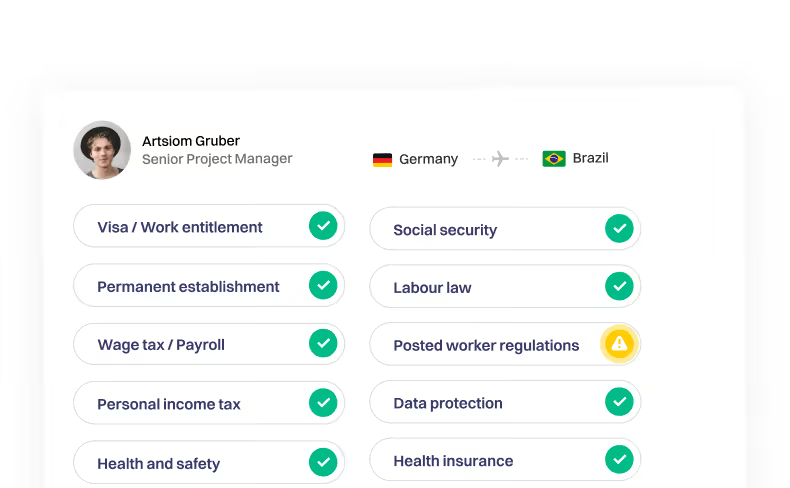
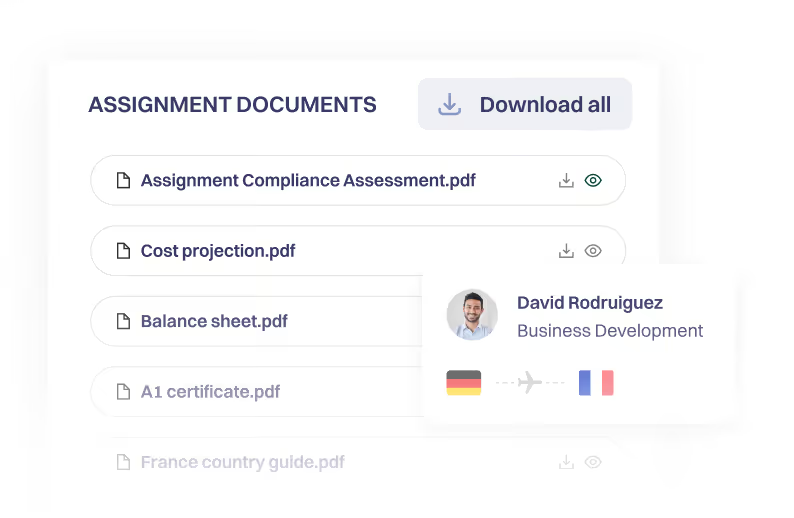
Assignment compliance assessment
Get instant evaluation of all 10 risk dimensions - visa, permanent establishment, wage tax/payroll, personal income tax, social security, labour law, posted worker regulations, data protection, health & safety, health insurance
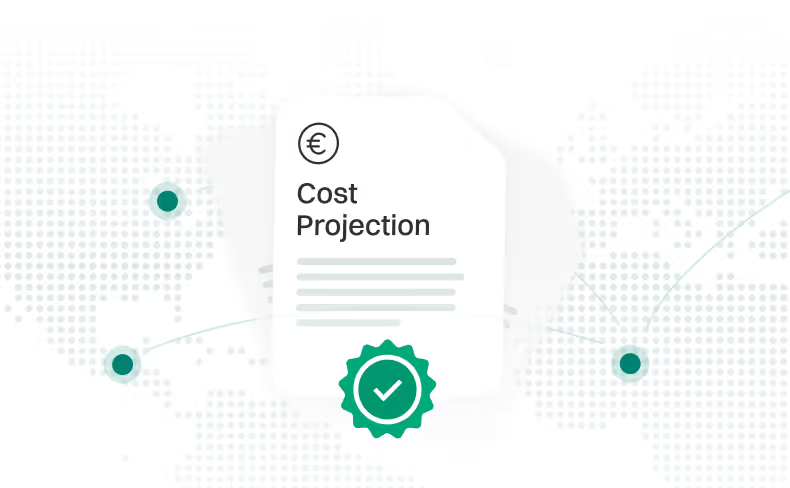
Cost projection & Balance sheet
AI-powered cost calculations with real-time benchmarks for taxes, allowances, insurance, benefits, and relocation costs - no more expensive index data
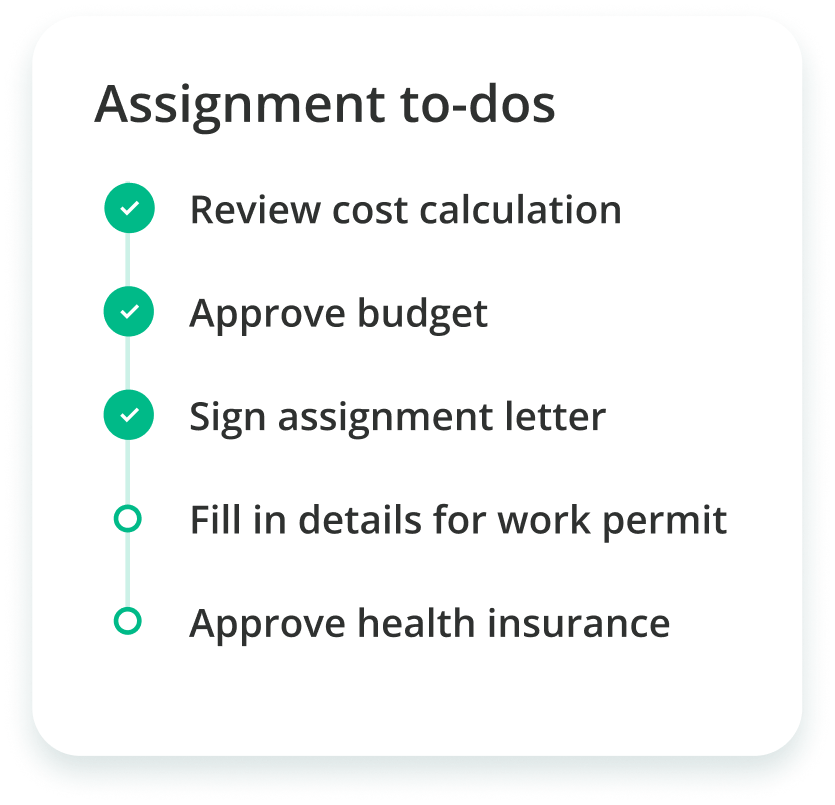
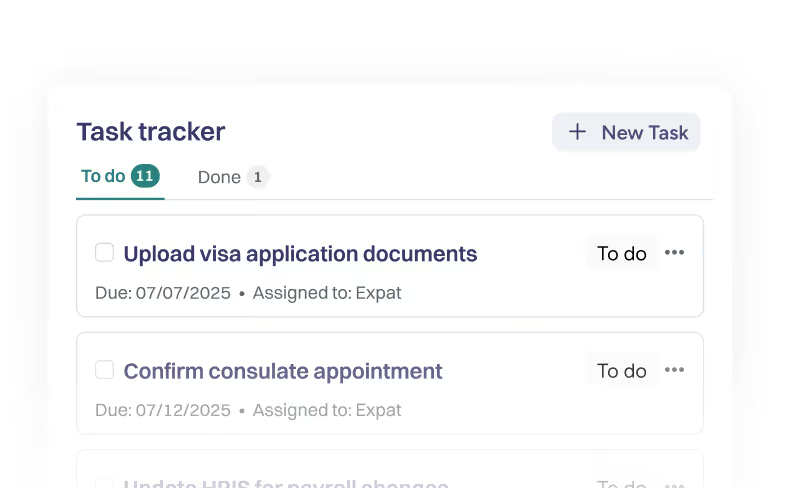
HR task tracker
Step-by-step guidance on country-specific compliance requirements, pre-assessment tasks, and arrival procedures tailored to your assignment type
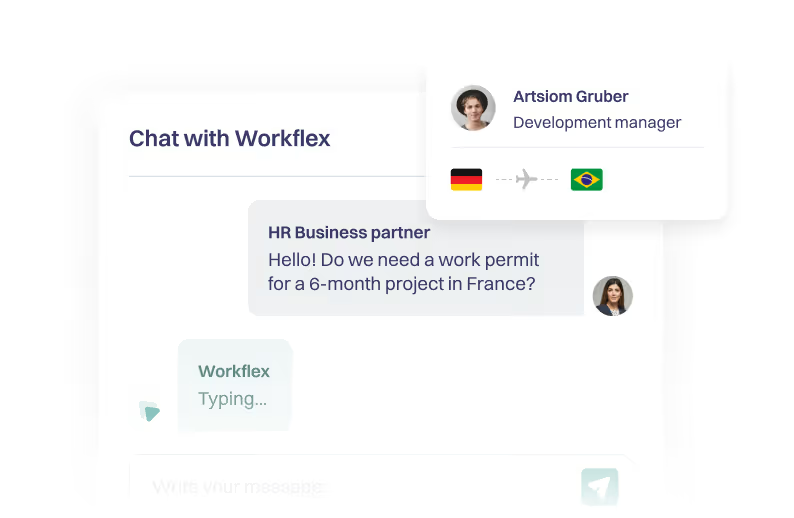
Assignment exploration chat
Unlimited compliance questions to human experts - explore scenarios and refine your assignment plan without consultant fees

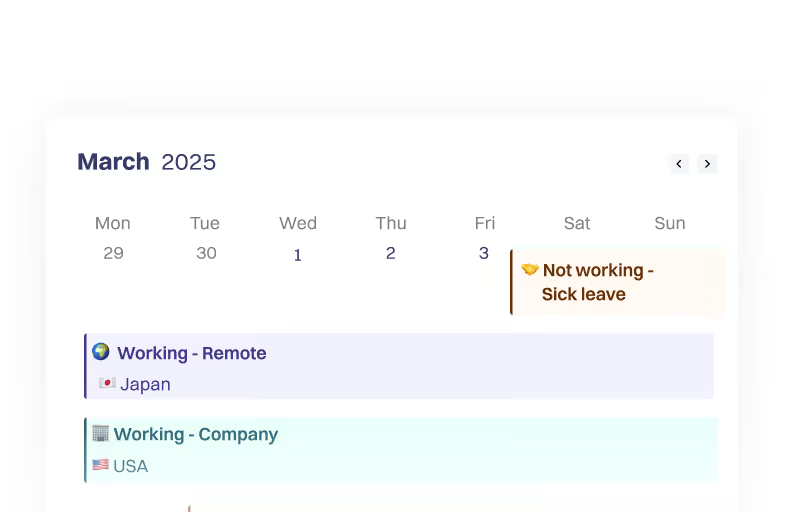
Travel calendar & Compliance tracking
Monitor business trips, workations, and time off during assignments for seamless tax reporting and PE risk management
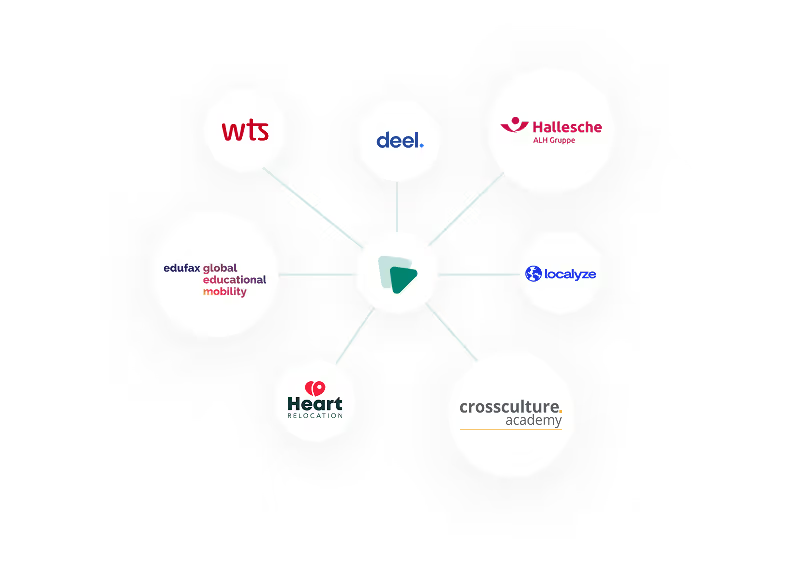
Vendor platform
Benefit from trusted partners for work permits, taxes, relocation, and insurance - all with access to complete assignment information throughout the assignment
Document repository
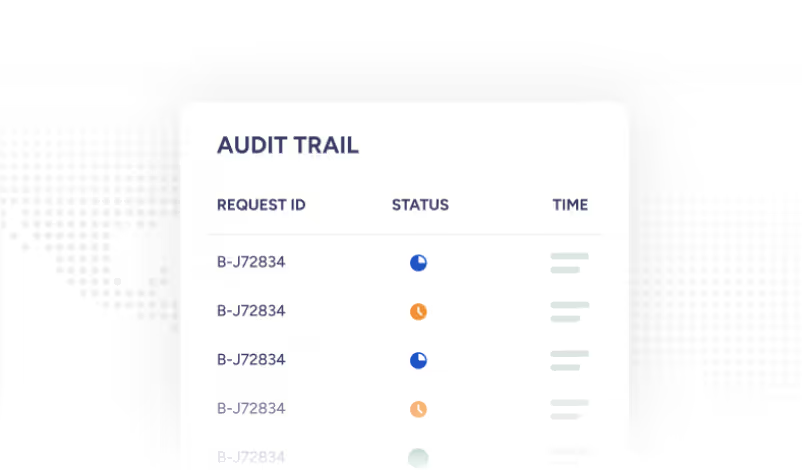
Centralized, secure storage for all assignment-related documents from A1 certificates to balance sheets with audit-ready organization
Real-time risk alerts and monitoring
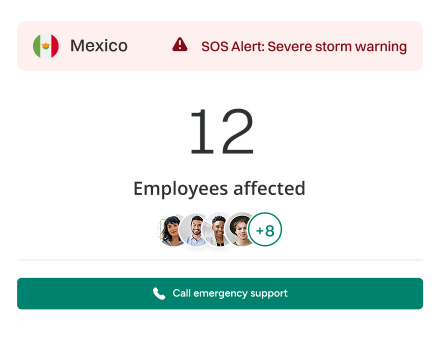
Get instant alerts when political unrest, natural disasters, or health crises emerge

24/7 SOS support
Multilingual support connects you instantly to doctors and emergency coordinators


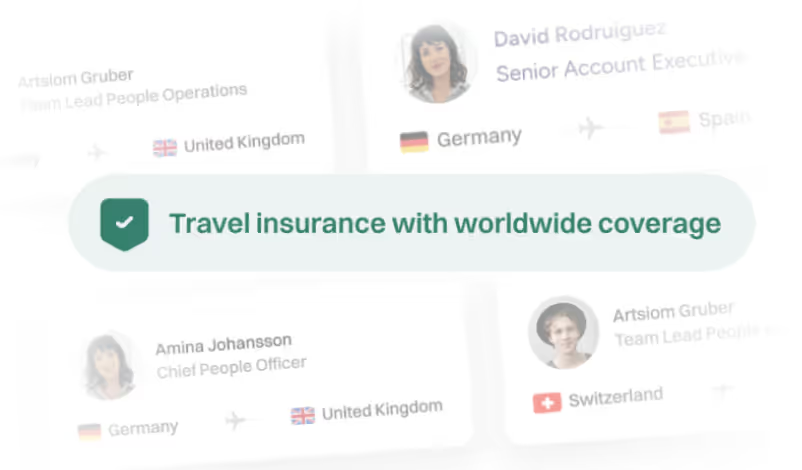
Travel health insurance
Medical coverage by ALH Group Hallesche added to every approved trip, worldwide




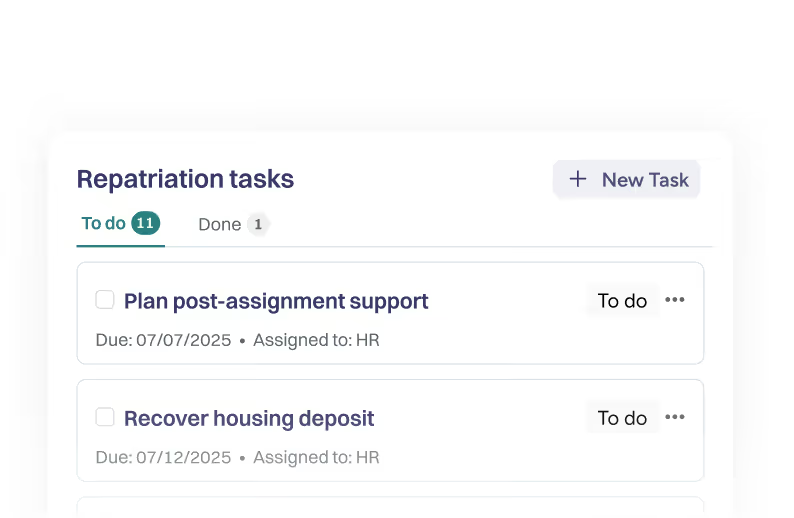
Repatriation management
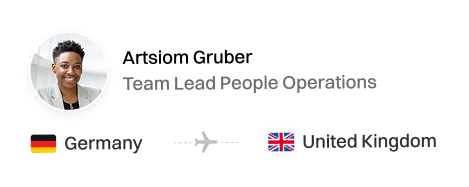
Get step-by-step repatriation checklists covering tax obligations, immigration requirements, social security transitions, payroll changes, and residence registration, and more
Vendor & Timeline coordination
Reduce your workload with WorkFlex as your single point of contact - we manage all vendors, deadlines, and documentation for seamless employee and family returns

Assignment compliance chat
Unlimited compliance questions for repatriation and ongoing obligations - get expert guidance on complex return processes and long-term tax requirements

€250K financial liability coverage
We assume liability for social security, corporate and employment tax if risks emerge
Built to ISO 31030 standards
Risk assessment, threat detection, prevention strategies, real-time monitoring, and audit records



Trusted by global mobility leaders worldwide

"WorkFlex's assignment services give us great insights at a much lower cost than our previous provider. We love that they also handle visas, A1 certificates, and PWD notifications, services we used to manage ourselves. It's truly a one-stop solution for all our assignment needs."
Eliminate assignment complexity
Stop letting assignment compliance overwhelm your team. See how WorkFlex automates 50+ manual tasks into streamlined workflows that deliver compliance confidence in minutes
What you'll discover:





Automate global mobility compliance with our all-in-one software
Join hundreds of employers transforming their global mobility compliance processes with WorkFlex

- Certified Dutch tax lawyer
- 16+ of global mobility compliance experience
- Former Tax Director at PwC

- Certified lawyer (Volljuristin)
- 25+ years of global mobility compliance experience
- Trainer at the People Mobility Academy

- PhD in European Law
- 12+ years of legal experience

- 20+ years of global mobility experience
- Chapter Lead at the The Forum for Expatriate Management (Germany, Switzerland)

- 8+ years of global mobility compliance experience
- Expertise in international assignment compliance

- Expertise in international assignment compliance
- 2+ years of global mobility compliance experience

- Certified Spanish tax lawyer
- 6+ years of legal experience

- 14+ years in travel risk and crisis response
- Ex-military

- 30+ years in healthcare leadership
- Healthcare risk management specialist with experience in patient safety, quality management, medical outcome assessments

- 6+ years of specialized emergency medical training
- Master of Science in Medicine

- 16+ years in global security and crisis management
- Ex-military
