
Global mobility COMPLIANCE
Travel to Brazil safely and compliantly
Planning on sending an employee to Rio de Janeiro? Or a business trip or assignment to São Paulo or Salvador? Learn the essential information you and your employees need to work safely and compliantly while in Brazil, including working conditions, safety and health regulations, tax treaties, social security, and more.

Download Compliance Guide for Brazil
As an employer, there are many things you need to consider before sending an employee to Germany. A handy PDF downloadable for free.
What you can expect
Capital city
Brasília
Telephone code
+55
Official language
Portuguese
Currency
Brazilian Real (BRL)
Time zone
Main: UTC-3
Visa
To work legally while in another country, employees generally need avalid work title. It's important to keep in mind that the consequences ofentering without the proper documentation can be significant for both the employee and the employer.
For those planning an assignment, business trip or work-from-anywheretrips to Brazil, here's a quick overview:
MUST-KNOW for Assignment in Brazil:
- CNPJ Entity Required: Employer sponsorship requires the existence of a registered Brazilian legal entity (CNPJ). Without one, sponsoring an assignee is not possible.
- Two-Thirds Rule: At least two-thirds of a company's workforce in Brazil must be Brazilian nationals. This quota applies to both headcount and payroll.
- Mandatory CLT Registration: Long-term assignees must be registered under the Brazilian labour consolidation law (CLT), which governs employment conditions, benefits, and contributions.
- Document Apostille + Sworn Translation: All supporting documents must be apostilled and accompanied by a sworn Portuguese translation. This is mandatory and a common source of delays.
- No Expedited Processing: Brazil does not offer any fast-track or priority processing option for work visas. Plan accordingly.
- Strict Business vs. Technical Visa Distinction: The type of activity determines the visa category. Misclassification can result in rejection or legal consequences for the employer.
Short Term Assignment: (Employer Sponsorship required)
- Visitor Visa (VIVIS): Valid for 90 days, extendable to 180 days; suitable for short-term business activities
- Visa-Free Entry: Available for many nationalities for short-term stays
- e-Visa: Available for US, Canadian, and Australian nationals since April 2025
Long-Term Assignment: (Employer Sponsorship required)
Typical Processing Time: 1.5- 3 months
- VITEM V - Temporary Work Visa: The standard long-term work visa for foreign assignees; initially granted for 2 years, renewable for up to 4 years
- NR 2 Work Permit: Issued in conjunction with the VITEM V; required for all paid employment activities in Brazil
Business trips:
- E-Visa: Will be available from 2025 for select nationalities.
- Visa-Free Entry: Available to many nationalities, including EU and Mercosur countries.
- Business Visa: Required for activities not covered by visa-free entry.
- Visa on Arrival: Not available for business travelers.
Need trip-specific visa information? Reach out WorkFlex Visa services.
Work-from-anywhere trips:
- Visa-free Entrance: Available to many nationalities, including EU countries and Mercosur members.
- E-Visa: From 2025, available for select countries including US, Canada, and Australia, valid for 10 years.
- Standard Visa: Required for nationalities not eligible for e-visa or visa-free entry, obtained through Brazilian consulates.
- Visa on Arrival: Not available - all required visas must be obtained before travel.
- Digital Nomad Visa: Brazil offers a Digital Nomad Visa (VITEM XIV), introduced in 2022, allowing remote workers to stay and work legally in the country for up to two years (1-year initial period with possible extension).
Need trip-specific visa information? Reach out WorkFlex Visa services.
Working hours
Most employees in Brazil work from Monday to Friday, with a standard workweek consisting of 44 hours. The workday is typically running from 9:00 AM to 6:00 PM, with a lunch break of 1 hour in between.
To remain compliant during your trip abroad, here are some suggestions to follow:
- Avoid working overtime: Regulations regarding overtime can differ significantly and may be much stricter compared to those in your home country.
- Refrain from working outside regular hours: The rules surrounding working outside regular hours may vary and could be stricter than in your home country.
- Do not work on weekends: If the weekend days differ from those in your home country, please avoid working on both your regular weekend days and the local weekend days.
Public holidays
Get information about specific public holiday dates for this year here.
- January 1: New Year's Day
- February 16: Carnival Monday (date varies annually, widely observed)
- February 17: Carnival Tuesday (date varies annually, widely observed)
- April 3: Good Friday (date varies annually)
- April 21: Tiradentes Day
- May 1: Labour Day
- June 4: Corpus Christi (date varies annually, widely observed)
- September 7: Independence Day
- October 12: Our Lady of Aparecida
- November 2: All Souls' Day
- November 15: Republic Proclamation Day
- November 20: Black Consciousness Day
- December 25: Christmas Day
Depending on the region you're visiting, there may be additional region-specific public holidays. For more information about these holidays, please check here.
To comply with labor laws, please refrain from working on national or regional holidays during your trip. These days hold significant importance for locals and provide a great opportunity for you to blend in and celebrate with the community.
Social security compliance
When working remotely abroad, your employees may become subject to the social security scheme of the destination country, which means you, asan employer, would need to pay social security premiums accordingly. Brazil's social security system is administered by the INSS (Instituto Nacional doSeguro Social). Brazil has entered into bilateral social security agreements with various countries to help prevent the payment of double social securitycontributions. Whether a bilateral agreement applies depends on the employee'scountry of origin — employers should verify whether such an agreement exists between Brazil and the relevant home country.
Where a bilateral agreement is in place, employees temporarily posted to Brazil can generally remain insured under the home country's socialsecurity system for a defined period, provided they hold a valid Certificate ofCoverage (CoC) issued by the relevant home country authority. Employers shouldverify the specific terms and duration limits of the applicable agreement. More information here.
Tax compliance
Brazil has signed bilateral tax treaties with a number of countries that specify the steps to take to avoid double taxation, available here. However, Brazil's tax treaty network is relatively limited compared to many other economies — employers should verify whether a Double Taxation Agreement (DTA) exists between Brazil and the employee's home country, as this directly affects the tax treatment of employment income. These treaties generally follow international standards and provide guidelines for various types of income, including employment income.
Despite the existence of many tax treaties, the issue of Permanent Establishment remains a significant compliance concern for employers with employees temporarily working in Brazil, whether for a workation, a business trip, or an assignment. If a travelling employee is deemed to constitute a Permanent Establishment in the destination country, the employer may be required to register the company locally, allocate profits to the local business (branch), and file corporate taxes, leading to substantial administrative burdens.
To avoid this scenario, here are some key strategies:
If your employees are travelling for a workation, they should refrain from negotiating or signing sales contracts during the trip. Additionally, they should avoid visiting clients or any office, including the employer's local office in the destination country. Following these guidelines will help mitigate the important compliance risk for the employer related to permanent establishment.
When it comes to business trips, it can be difficult to avoid the above-mentioned activities. In such cases, it is advisable to coordinate with the (tax) compliance department. WorkFlex users can handle this topic directly via the WorkFlex platform.
For an assignment in Brazil, the permanent establishment risk is significantly elevated. Given the duration and nature of the assignment activities, such as representing the employer, managing local teams, or concluding contracts, the establishment of a permanent establishment is highly likely. In addition, employees who spend more than 183 days in Brazil within a 12-month period are considered Brazilian tax residents and are subject to Brazilian income tax on their worldwide income. Employers are strongly advised to conduct a permanent establishment risk analysis before the assignment begins and to implement a Tax Equalisation Policy. WorkFlex users can handle this topic directly via the WorkFlex platform.
Overriding local employment provisions
Employees travelling to Brazil must comply with certain fundamental local employment regulations that may qualify as mandatory law, such as minimum wage standards. Employment relationships in Brazil are governed by the Consolidação das Leis do Trabalho (CLT), which applies to all employees working in Brazil, regardless of the employer's home country. Current information on the minimum wage in Brazil can be retrieved here.
Local emergency phone
192 (Medical), 190 (Police)
Vaccination
Guidelines
Drinking potable water
Not recommended
Travel health insurance
When traveling to Brazil for work—whether for a short business trip or an extended workation—it's essential to have comprehensive health insurance coverage to ensure access to medical care.
For business trips, the employer typically arranges the employee's travel health insurance. However, for workations, these responsibilities can be less clear. WorkFlex takes care of travel health insurance for trips worldwide to ensure there are no costly consequences for either the employee or the employer if accidents occur while working abroad.
For travelers using WorkFlex
If you’re traveling with WorkFlex, comprehensive health insurance is automatically included if your employer has activated this feature. For more details, please refer to your trip request on the WorkFlex platform.
For other travelers
Ensure you have travel health insurance with worldwide coverage, whether for a workation or business trip, so that you can receive adequate medical treatment in case of an emergency.
Urgent safety information
For travelers using WorkFlex:
Please refer to your trip's risk assessment under the "Health and Security" dimension to review any urgent security information relevant to your travel.
For other travelers:
Please visit official authority websites to check for any current threats or urgent security advisories:
Terrorism
Follow the general cautionary measures.
Domestic political situation
Due to the ongoing crisis in Venezuela, coupled with issues of gang crime, smuggling, and the movement of refugees, the presence of security forces in the region is limited. Travelers are strongly advised to avoid the immediate border area, as closures may happen unexpectedly.
- Stay updated through local media.
- Avoid demonstrations and large crowds.
- Follow local security forces’ instructions.
- Refrain from travel or stays near the border region with Venezuela.
Crime
Crime rates and the risk of violent crimes, including robberies, are high in Brazil, especially in major cities such as Belém, Fortaleza, Maceio, Porto Alegre, Recife, Rio de Janeiro, Salvador, São Luiz, and São Paulo. Slum areas (favelas) are particularly dangerous due to gang and drug-related violence, with police operations often leading to bystander casualties. Criminal incidents are common in quieter city streets, beaches, and roads leading to airports.
General safety recommendations:
- Secure important documents, and store electronic copies/photos.
- Use cashless payments; carry minimal cash and avoid valuables.
- Avoid flashy clothing, visible watches, or smartphones in public.
- Always have a small amount of cash to surrender if robbed.
- Avoid leaving drinks unattended in bars or similar venues.
- Do not invite casual acquaintances to your hotel.
- Avoid long-distance travel at night to minimize the risk of staged accidents or carjackings.
- Keep car windows closed, doors locked, and valuables out of sight when driving.
- Be extra vigilant at traffic lights and in slow traffic.
- Use the middle lane on roads with multiple lanes.
- Prefer taxis to public transport at night.
- Verify online travel offers and avoid suspicious luggage from strangers.
- Be cautious with unsolicited communications (emails, calls, prize notifications).
Rio de Janeiro
- The entire city, including popular areas like Copacabana, Ipanema, and Lapa, has frequent thefts and muggings.
- Perpetrators often target mobile phones, jewelry, and credit cards.
- Credit card skimming and fraud, especially in taxis, is common.
- The city center is unsafe after business hours, weekends, and public holidays.
- Favelas frequently experience shootings that may harm bystanders.
- Prefer group hikes on well-marked trails.
- Avoid nighttime beach walks and paying by card in taxis.
- Do not visit any favelas, even in the South Zone.
São Paulo
- The historic center, including areas like Praça da Sé, is unsafe at night and during non-business hours.
- Estação da Luz and nearby areas should be avoided during these times.
- Armed robberies and express kidnappings occur, even in upscale areas.
- Caution is advised city-wide, including upscale neighborhoods.
Northeast Brazil
- The region, particularly Bahia and its capital Salvador, has the highest violent crime rates.
- Drug gangs and police clashes are common.
- Cities like Fortaleza, Natal, and Recife are among the most dangerous globally.
- Armed robberies targeting tourists and private vehicles are not uncommon.
- Avoid displaying valuables, stay vigilant during the day, and prefer taxis or rideshare services over public transport.
- Refrain from walking at night or taking overnight bus trips.
USE CASES
What assignments can you cover with the WorkFlex solution?
From Europe to Asia, Americas to Africa - WorkFlex handles compliance complexity for any country combination worldwide, covering all your international secondment scenarios
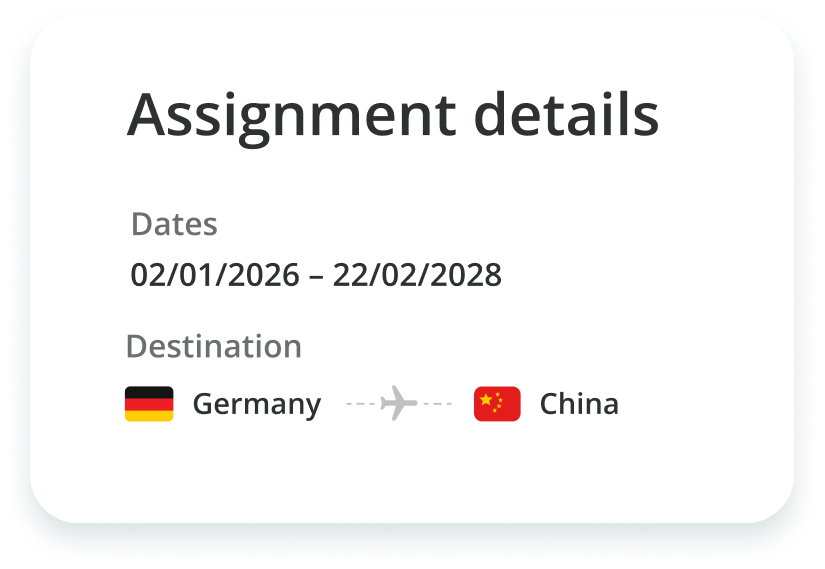
Long-term strategic deployments lasting 1-3 years to establish new entities, fill key management roles, or transfer critical expertise to international markets

Structured programs where employees work temporarily with partner organizations, subsidiaries, or different departments to share knowledge, develop skills, and build cross-cultural competency

Deployment of specialized teams to execute international projects, like system implementations, market launches, or technical installations. Often takes place in groups, requiring coordination of multiple compliance requirements simultaneously

Solution
Transform your approach to international assignments with WorkFlex
International assignments shouldn't overwhelm your HR team. Let WorkFlex automate the complexity
Get information about specific public holiday dates for this year here.
- Complete overview of your staff assignments in just a few minutes
- Replace Excel chaos with standardised automation
- Reduce costly reliance on consultants
- Gain complete transparency over all assignments
Depending on the region you're visiting, there may be additional region-specific public holidays. For more information about these holidays, please check here.
Hundreds of companies trust WorkFlex to handle business travel compliance







FEATURES
End-to-end assignment management across every phase
Assignment compliance assessment
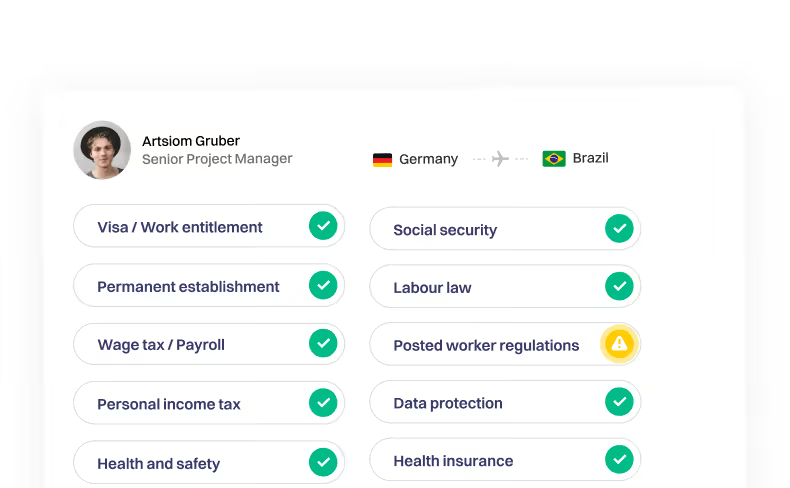
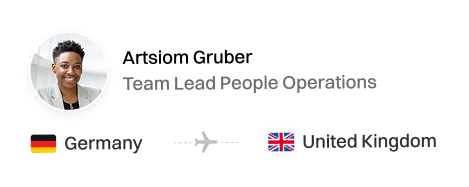
Get instant evaluation of all 10 risk dimensions - visa, permanent establishment, wage tax/payroll, personal income tax, social security, labour law, posted worker regulations, data protection, health & safety, health insurance
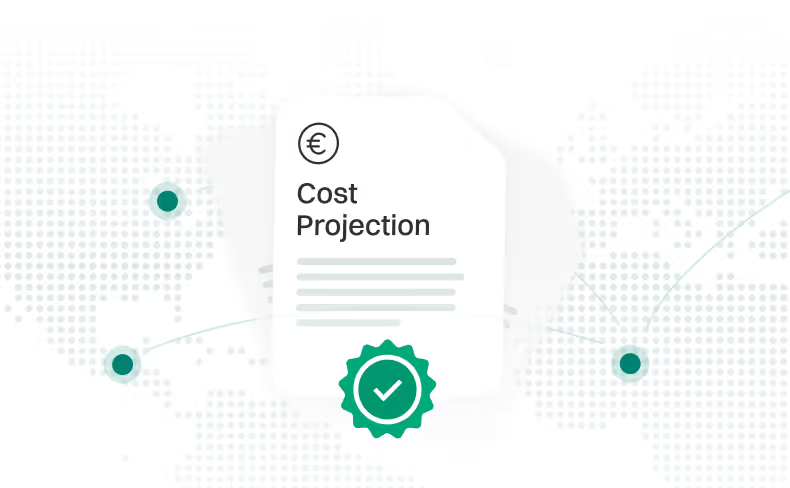
Cost projection & Balance sheet
AI-powered cost calculations with real-time benchmarks for taxes, allowances, insurance, benefits, and relocation costs - no more expensive index data
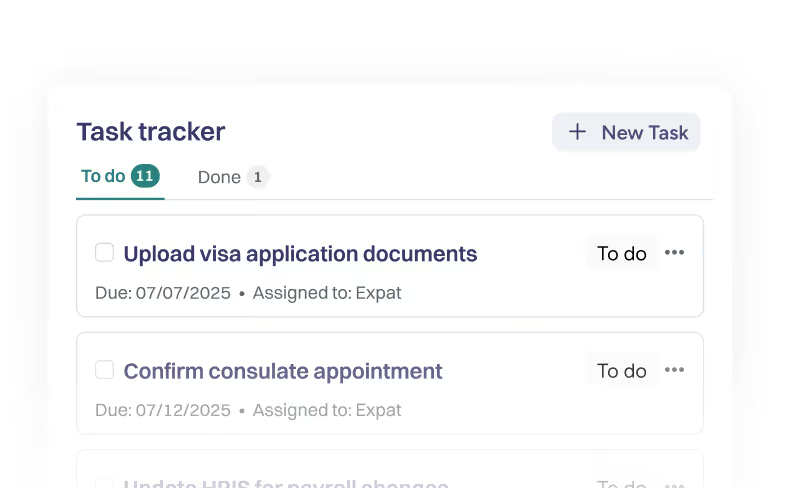
HR task tracker
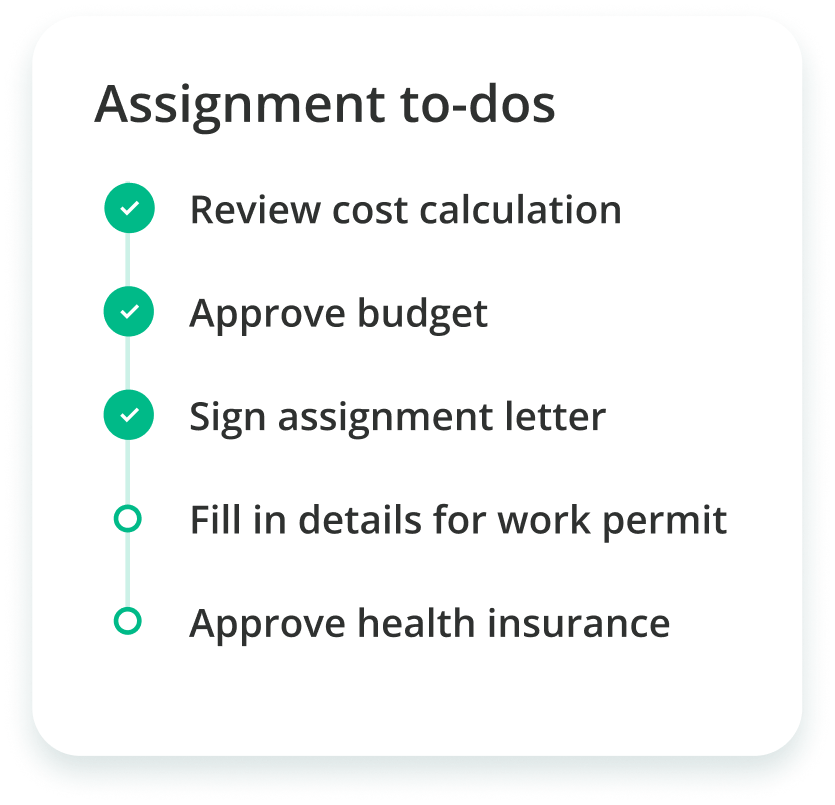
Step-by-step guidance on country-specific compliance requirements, pre-assessment tasks, and arrival procedures tailored to your assignment type
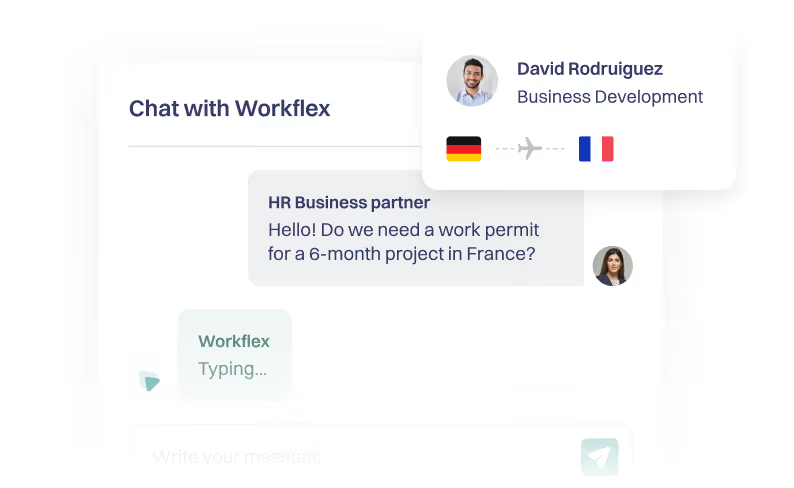
Assignment exploration chat
Unlimited compliance questions to human experts - explore scenarios and refine your assignment plan without consultant fees
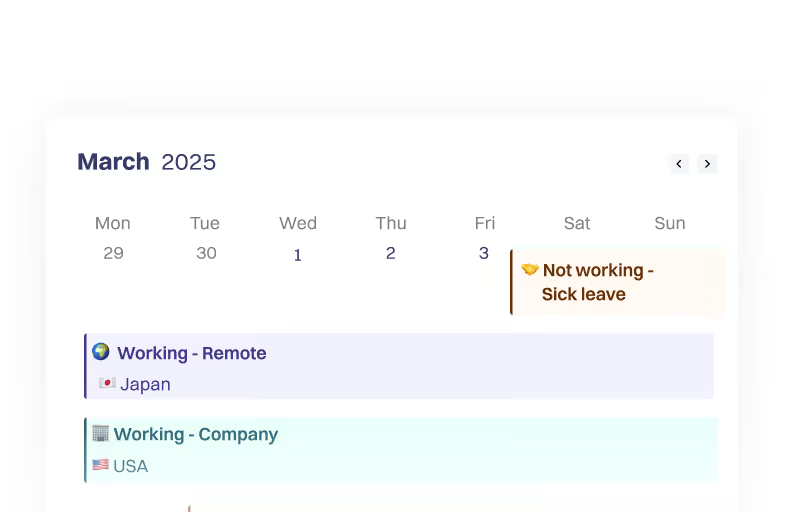
Travel calendar & Compliance tracking
Monitor business trips, workations, and time off during assignments for seamless tax reporting and PE risk management
Vendor platform
Benefit from trusted partners for work permits, taxes, relocation, and insurance - all with access to complete assignment information throughout the assignment
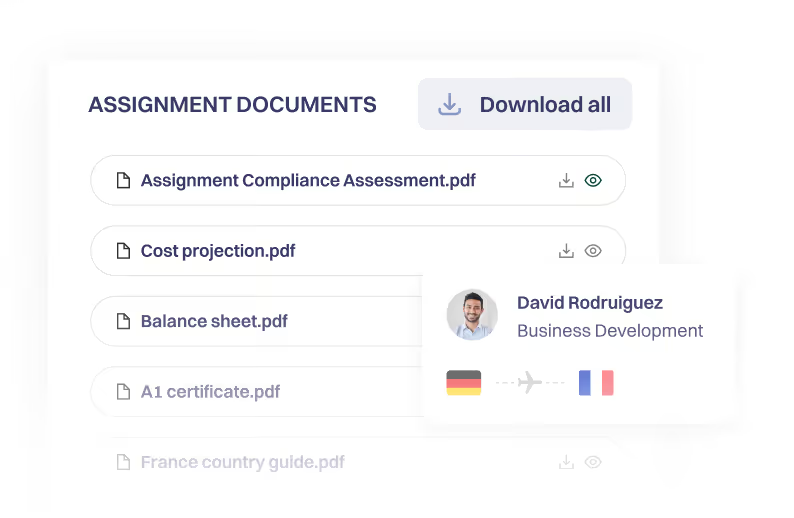
Document repository
Centralized, secure storage for all assignment-related documents from A1 certificates to balance sheets with audit-ready organization
Real-time risk alerts and monitoring
Get instant alerts when political unrest, natural disasters, or health crises emerge

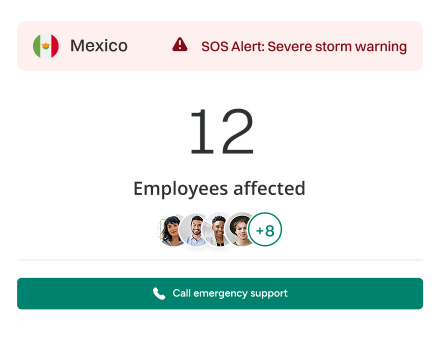
24/7 SOS support
Multilingual support connects you instantly to doctors and emergency coordinators


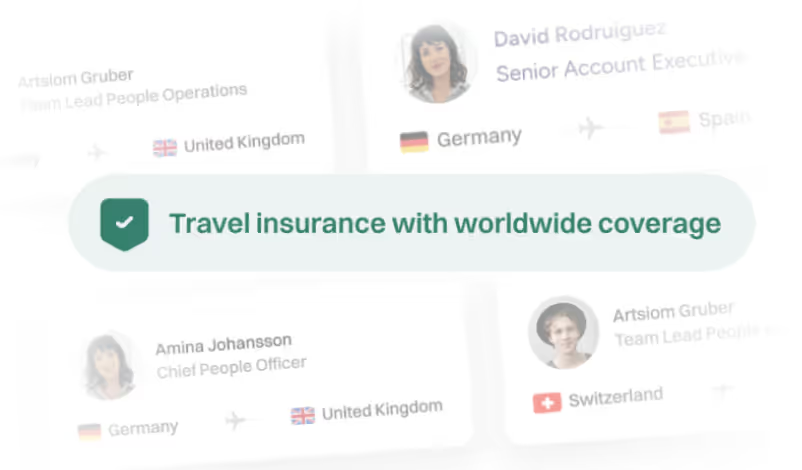
Travel health insurance
Medical coverage by ALH Group Hallesche added to every approved trip, worldwide




Repatriation management
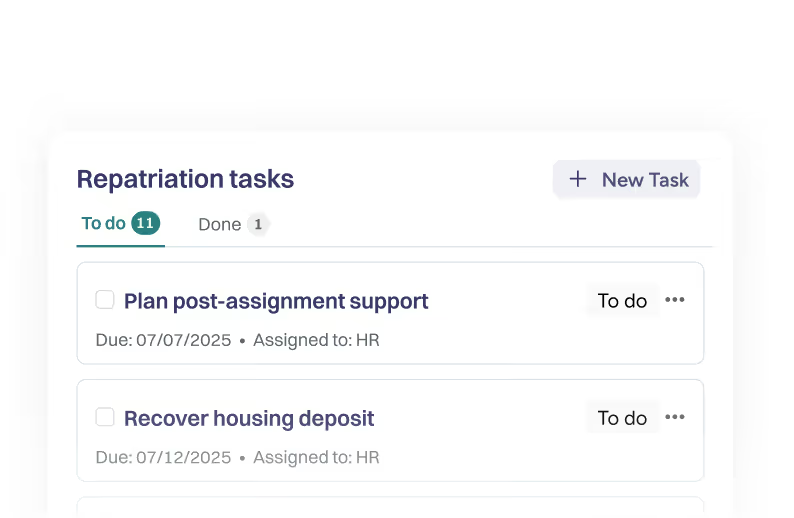
Get step-by-step repatriation checklists covering tax obligations, immigration requirements, social security transitions, payroll changes, and residence registration, and more
Vendor & Timeline coordination
Reduce your workload with WorkFlex as your single point of contact - we manage all vendors, deadlines, and documentation for seamless employee and family returns

Assignment compliance chat
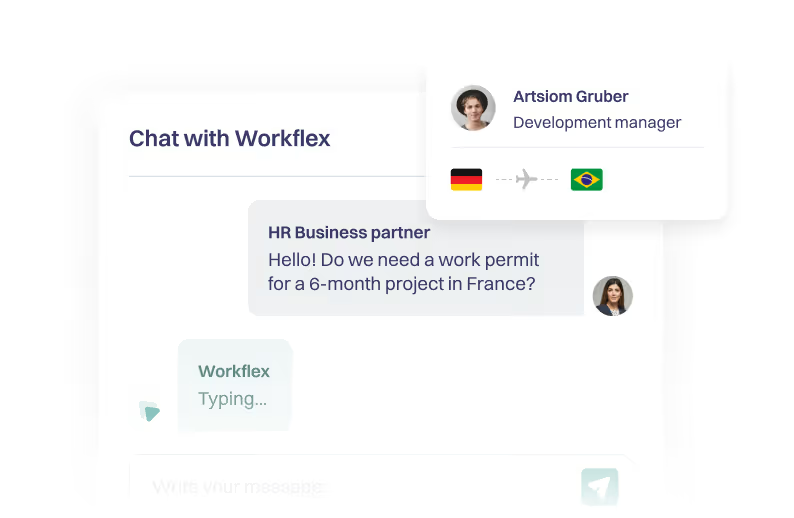
Unlimited compliance questions for repatriation and ongoing obligations - get expert guidance on complex return processes and long-term tax requirements

€250K financial liability coverage
We assume liability for social security, corporate and employment tax if risks emerge
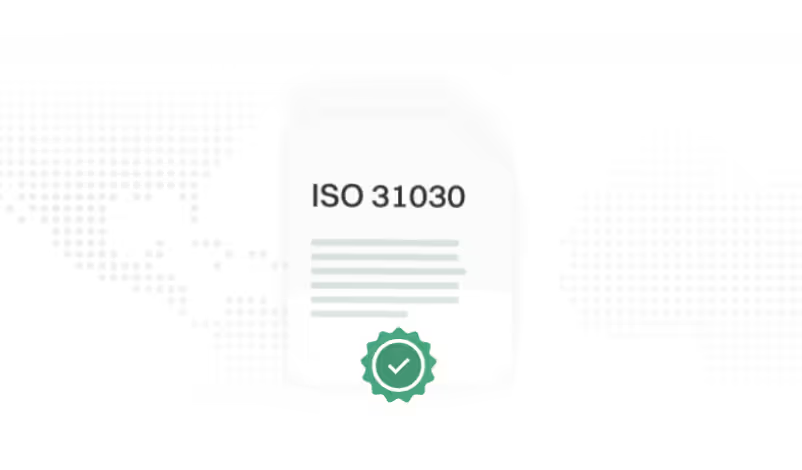
Built to ISO 31030 standards
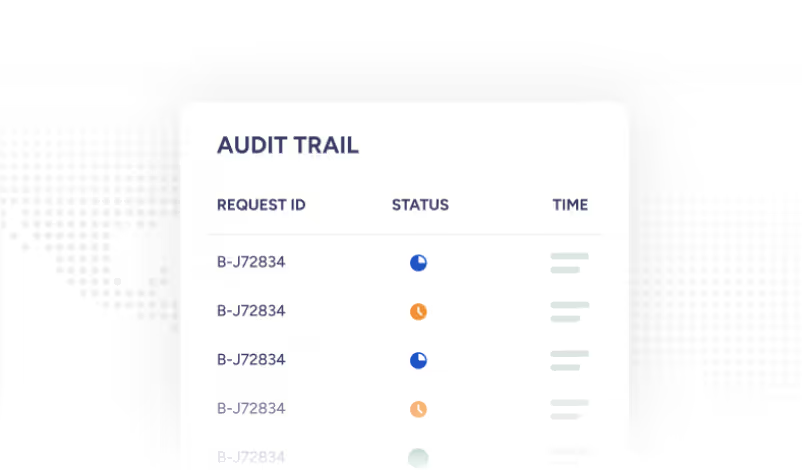
Risk assessment, threat detection, prevention strategies, real-time monitoring, and audit records



Trusted by global mobility leaders worldwide

"WorkFlex's assignment services give us great insights at a much lower cost than our previous provider. We love that they also handle visas, A1 certificates, and PWD notifications, services we used to manage ourselves. It's truly a one-stop solution for all our assignment needs."
Eliminate assignment complexity
Stop letting assignment compliance overwhelm your team. See how WorkFlex automates 50+ manual tasks into streamlined workflows that deliver compliance confidence in minutes
What you'll discover:






Automate global mobility compliance with our all-in-one software
Join hundreds of employers transforming their global mobility compliance processes with WorkFlex

- Certified Dutch tax lawyer
- 16+ of global mobility compliance experience
- Former Tax Director at PwC

- Certified lawyer (Volljuristin)
- 25+ years of global mobility compliance experience
- Trainer at the People Mobility Academy

- PhD in European Law
- 12+ years of legal experience

- 20+ years of global mobility experience
- Chapter Lead at the The Forum for Expatriate Management (Germany, Switzerland)

- 8+ years of global mobility compliance experience
- Expertise in international assignment compliance

- Expertise in international assignment compliance
- 2+ years of global mobility compliance experience

- Certified Spanish tax lawyer
- 6+ years of legal experience

- 14+ years in travel risk and crisis response
- Ex-military

- 30+ years in healthcare leadership
- Healthcare risk management specialist with experience in patient safety, quality management, medical outcome assessments

- 6+ years of specialized emergency medical training
- Master of Science in Medicine

- 16+ years in global security and crisis management
- Ex-military
